When people picture the Berlin Wall, they usually imagine a single painted barrier. It was never that simple. What ringed West Berlin for 28 years was a system — an inner wall, a floodlit "death strip," patrol roads, tripwires, and an outer wall — running roughly 155 kilometres in total. When it opened on the night of 9 November 1989, Berliners took it apart with astonishing speed. Within two years almost all of it was gone. So the honest answer to "where can I see the Wall?" is: in a handful of carefully chosen places, and in a thin double line of cobblestones that still traces its course through the city.
Here's where I take people, and why.
Bernauer Straße — the one to see first
If you visit only one Wall site, make it the Berlin Wall Memorial (Gedenkstätte Berliner Mauer) on Bernauer Straße. This is the only place that preserves the full depth of the border: the inner wall, the raked death strip, and a surviving watchtower, seen from a viewing platform that finally lets the geography make sense.
Bernauer Straße was one of the cruellest streets in the city, because the buildings stood in the East while the pavement belonged to the West. In the first days people jumped from upper windows into rescue nets below; the windows were later bricked up, then the houses demolished. The Chapel of Reconciliation stands where a church was dynamited by the GDR in 1985 simply because it sat in the way. The Window of Remembrance shows the faces of those who died trying to cross. It's moving without ever being showy.
Checkpoint Charlie — see it, then move on
I'll be straight with you: Checkpoint Charlie today is the most disappointing Wall site in Berlin. The guardhouse is a replica, the "soldiers" are actors charging for selfies, and fast-food chains crowd around the famous "You are leaving the American Sector" sign. And yet the spot matters — this is where American and Soviet tanks stood barrel to barrel in October 1961, one of the moments the Cold War came closest to going hot. Read the free open-air panels, then walk on. Nearby on Zimmerstraße, a quiet memorial marks where Peter Fechter was shot and left to bleed in the death strip in 1962, in full view of both sides.
Niederkirchnerstraße — the original outer wall
Beside the Topography of Terror, a roughly 200-metre stretch of the original outer Wall still stands on Niederkirchnerstraße, now a protected monument. It's battered and full of holes — this is where the "wall woodpeckers" of 1989 hacked out chunks with hammers. Standing next to the real thing, grey and unpainted, tells you more than any restored section.
East Side Gallery — the Wall as canvas
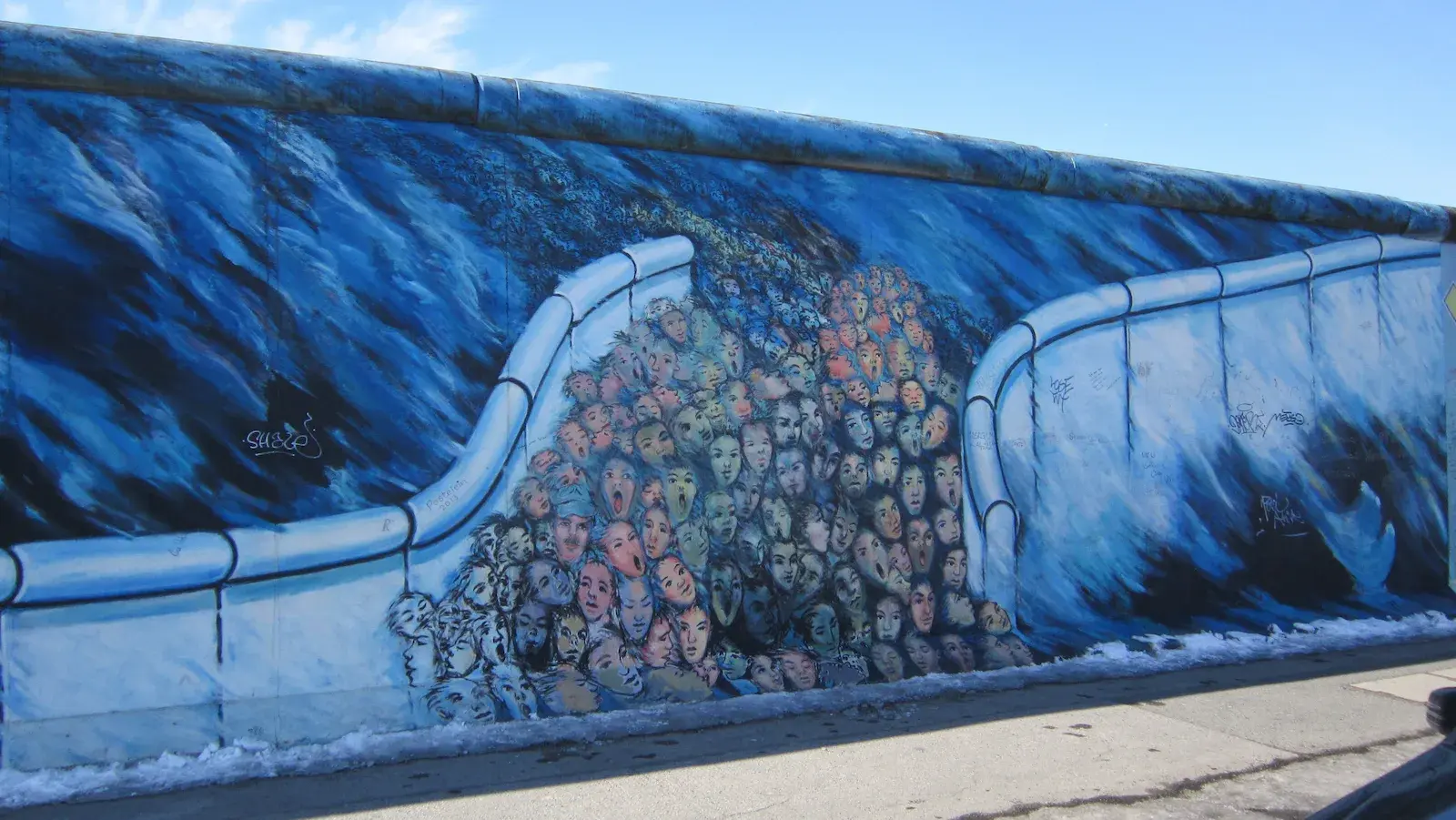
The East Side Gallery is the longest surviving piece, 1.3 kilometres along the Spree in Friedrichshain. Artists from around the world painted it in 1990, after the border was already open — so think of it as a monument to the fall rather than a relic of the division itself. You'll recognise Dmitri Vrubel's socialist "fraternal kiss" between Brezhnev and Honecker, and Birgit Kinder's Trabant bursting through the concrete. It gets busy; go early.
The traces you'd otherwise miss
- The double row of cobblestones set into roads and pavements across the centre, marked "Berliner Mauer 1961–1989," showing exactly where it ran.
- The Palace of Tears (Tränenpalast) at Friedrichstraße station — the old border crossing hall where Easterners said goodbye to Western visitors, now a free and very good exhibition.
- The "ghost stations" — U-Bahn and S-Bahn stops in the East that Western trains rolled through without stopping, sealed and guarded, for nearly thirty years.
How much time do you need?
Half a day covers Bernauer Straße and one or two other sites at a proper pace. A full day lets you follow the story from division to the night it fell. What ties these scattered places together is the human story — the escapes, the families split for a generation, the border guard who finally raised the barrier. That's exactly what my Divided Berlin tour is built around, following one East Berliner's life from the building of the Wall to the night it came down. The concrete is only half of it; the people are the rest.
Related tour
Third Reich Tour
The era of National Socialism told through my grandfather's stories.